Wednesday, June 17, 2015

A natural born tree right in my own backyard!

As some of my readers may have noticed, I spend a lot of time these days among trees, paying attention to trees, cutting back invasive trees to save native trees, etc.

And one thing that I came to realize is that at least in an area like Chicagoland, humans tightly control the reproduction of trees. 

I live on a lovely tree-lined street. Big trees - 100 ft tall or more. Maples, oaks, ash....but there are no baby trees, except for smallish trees that the city plants when they have to remove diseased trees (such as all the ash trees, under assault from ash borers).

It makes me sad to think of how impoverished my immediate surroundings are, how unnatural. We don't even let trees - majestic living things that make our lives possible, that live through many of our own generations - live out natural life cycles. 

In fact, I have come to accept that trees planted singly along streets to enhance our lives are really just ornaments. If "a man is not an island" then certainly a tree is not a forest. And very few trees live naturally outside of forests of many, many trees.

Well, enough of sadness. Veva and I were sitting on our patio last week, enjoying the (finally) warm weather and our lovely garden (thanks to Veva), when she pointed out something truly wonderful:


Can you see it? We planted the birch trees years ago. They are now 40 feet tall, but nestled in between? A natural born baby birch tree! Can't see it? Here maybe this will help:


I feel so much better now. The (minimal) wildness of our garden (as in: no grass) made it possible for a birch seed to take hold and grow. A tree that humans did not plant and hopefully will allow to grow to maturity.

Humans love to debate things like "Do plants feel?" Of course, it is terribly difficult for us to imagine such a thing - because the way that plants would think and feel would be so different from us. So we will likely never really be able to answer the question.

Which means it would make a lot more sense to err on the side of caution and assume that trees and plants and creatures do feel, do think in their own way, do take joy in life.

And watching this natural born tree grow, it is certainly easy to believe that it is joyful. I sure am.


Saturday, May 16, 2015

The human being is the only animal that...

Last night, I decided to re-read Stumbling on Happiness, a book I'd discovered a few years ago and was (then) delighted with. 

I chose that over one of my (back then) favorite books of fiction, because I'd been thinking yesterday and how odd it is that lots of left-leaning humans are all upset about climate change and really pissed at their elected officials about their non-action on this literally world-changing issue at a time when radical action is necessary - yet they don't take radical action in their own lives.

It's pretty clear that politicians will not change direction (will not override the influence of the source of their funding), until their constituents demonstrate a deep desire for change, backed up by action.

Anyway, there I was wondering once again about humans and why we behave the way we do. And so I sought out some answers in SoH. After all, the renowned Malcolm Gladwell, author of The Tipping Point, says right on the cover: 
"If you have even the slightest curiosity about the human condition, you ought to read it. Trust me."
OK, so fine. If a person says "trust me", usually you want to run in the other direction. But hey....

So I started reading and soon found Daniel Gilbert talking about psychologists are expected sometime in their career to finish The Sentence that starts with "The human being is the only animal that..." and now it was his turn.

Exciting! And then he finished the sentence:
"The human being is the only animal that thinks about the future."
And then you know what I did?

I stopped the reading book - and tossed it into the recycle bin. Yep, I threw the book away. That's how much Gilbert disgusted me, right then and there.

Why? Because of all the things we know about the world and the way it "works", the one thing we can never know is what another animal - even another human - is actually, truly thinking

All we can know, all we can see, all we can measure, and then draw conclusions from, is how an animal manifests their thinking into the world.

Gilbert cites as one "proof" of his Sentence that squirrels will, ahem, squirrel away nuts in advance of winter even in places where they will then find, winter after winter, that nuts or other food remain abundant. 

Go, Gilbert, go! Apply a human frame of judgement onto other animals, sure, why not? Why not assume that means that squirrels don't think about the future, rather than saying: "Maybe they do think about the future and know that they cannot trust what the future will bring, because they are not willing to destroy forests to build houses to hide them from the vagaries of the future."

So I threw out the book, but that got me thinking about The Sentence. I thought I would offer my own variations on that statement and invite others to do the same. Here goes...

The human being is the only animal that:
  • creates garbage, including vast "islands" of plastic in the middle of our oceans
  • causes the extinction of entire species, year in and year out
  • poisons water, the source of all life on this planet
  • learns multiple languages
  • holds it in
And just to pre-empt some typical responses:

The human being is the not only animal that:
  • creates art - lots of birds do, too. Just check out nests of bowerbirds.
  • has a sense of right and wrong - black bears do, too. Just check out Among the Bears. Seriously: READ THIS BOOK.
  • uses tools - birds, chimpanzees and others repurpose stones, branches, etc. as tools
  • is altruistic - again, black bears, and even more so ants. Many species of ants are way more altruistic than humans.
So what can you think of that only a human does? And please don't tell me about your belief about internal states of mind. That's just an opinion. Tell me about what humans do.


Sunday, April 12, 2015

In what ways is buckthorn harmful?

I spent 10-15 hours a week in various locations of still-wooded Chicago (and now nearby Lincolnwood) cutting down buckthorn. Some people have taken me to task for it ("Just let it be, let nature take it's course, etc.). So I thought I would share this excellent, concise sum up of the damage that can be wrought by buckthorn.

And if anyone lives on the north side of Chicago and would like to help out, there is both "heavy" work (cutting large trees and dragging them around) and now lots of "light" work (clipping the new growth from the stumps from last year's cutting - I don't use poison). 

It's great exercise and without a doubt you will be helping rescue native trees and ensure that the next generation of those trees will survive and thrive!


Buckthorn should be on America's "Most Wanted" list, with its picture hanging up in every US Post Office! Here are a few of the dangers of Buckthorn:

a) Buckthorn squeezes out native plants for nutrients, sunlight, and moisture. It literally chokes out surrounding healthy trees and makes it impossible for any new growth to take root under its cancerous canopy of dense vegetation.

b) Buckthorn degrades wildlife habitats and alters the natural food chain in and growth of an otherwise healthy forest. It disrupts the whole natural balance of the ecosystem.

c) Buckthorn can host pests like Crown Rust Fungus and Soybean Aphids. Crown Rust can devastate oat crops and a wide variety of other grasses. Soybean Aphids can have a devastating effect on the yield of soybean crops. Without buckthorn as host, these pests couldn't survive to blight crops.

d) Buckthorn contributes to erosion by overshadowing plants that grow on the forest floor, causing them to die and causing the soil to lose the integrity and structure created by such plants.

e) Buckthorn lacks "natural controls" like insects or diseases that would curb its growth. A Buckthorn-infested forest is too dense to walk through, and the thorns of Common Buckthorn will leave you bloodied.

f) Buckthorn attracts many species of birds (especially robins and cedar waxwings) that eat the berries and spread the seeds through excrement. Not only are the birds attracted to the plentiful berries, but because the buckthorn berries have a diuretic and cathartic effect, the birds pass the seeds very quickly to the surrounding areas of the forest. This makes Buckthorn spread even more widely and rapidly, making it harder for us to control and contain.

Monday, April 06, 2015

Consumer Reports guide on which fruits and veggies to always buy organic

First, I encourage everyone reading this (and beyond) to subscribe to Consumer Reports and make use of their unbiased, science-based reviews of products and services.

It is the best antidote to advertising you will ever find.

In their May 2015 issue, they analyze the "perils of pesticides" and offer a guide to fruits and vegetables. When you should buy organic? When might conventional be OK for you?

[or, as CR puts it, "Though we believe that organic is always the best choice because it promotes sustainable agriculture, getting plenty of fruits and vegetables - even if you can't obtain organic - takes precedence when it comes to your health.]

Here are the most important findings:

ALWAYS BUY ORGANIC

CR found that for these fruits and vegetables, you should always buy organic - the pesticide risk in conventional is too high.

Fruit

Peaches
Tangerines
Nectarines
Strawberries
Cranberries

Vegetables

Green Beans
Sweet Bell Peppers
Hot Peppers
Sweet Potatoes
Carrors

Tuesday, February 24, 2015

Who enjoys the feather display of a male peacock?


Who appreciates the display of feathers by a male peacock?

Female peacocks seem to get a kick out of them. They seem to play a role in mating rituals.

Who else? Why, humans, of course!

We know that humans greatly appreciate those displays, because of the aaahing and ooohing that goes on when we see them. We like those colors. We like the irridescence. We like the shapes and patterns.

If one were to speculate on why a female peacock gets all worked up about a particular male's feather display, we would inevitably hear about instinctual responses, hard-wiring, genetic determinism, and so on.

And if one were to speculate on why a human goes into raptures, we would then experience a major shift in explanation. 

Time to talk about anything but a physiological, hard-wired sort of response.

No, for humans, the attraction has to do with our big brains, our ability to create and appreciate "art". And that is most definitely not something other animals do, right?

Oh, sure, right. Like these instinctive, hard-wired bowerbird mating nests:


That clearly has nothing to do with an aesthetic sense or "art". Just instinct.

Why? Because we humans say so. We just assert this "fact."

Most convenient, eh?

Thursday, January 01, 2015

Four Secrets of Success

More than a few people think that I am pretty good at what I do, that I am successful. I respect their judgement and thought about what contributed to my success. I came up with four that form a foundation for (my) success. Since it is possible that others will find them helpful, I have decided to share my Four Secrets of Success (book in the works, film rights sold to Branjolina Films).

Follow these four recommendations, and you will be more successful in anything and everything you seek to accomplish.

1. Drink lots of water.

if you are dehydrated, nothing about you is operating optimally. By the time you realize you are thirsty, you are depleted. You are tired and listless. You think about getting another cup of coffee but your stomach complains at the thought.

No problem. Just get yourself a big glass of water, room termperature, no ice, and drink it down. You will feel the very substance of life trickle into your body and bring you back to life. Then drink another glass. 

Couldn’t hurt to try, right?

2. Work your abs.

What they say about a strong core? It’s all true. Strengthen your abdominal muscles and you will be amazed at the change in your life. I vouch for it from my own experience. 

I’m not talking about buying an Ab-Roller or going nuts with crazy crunches. Just do something every day, and see if you can do a little more every day. 

Couldn’t hurt to try, right?

3. Go outside. 

Preferably amongst trees, in a forest. 

We did not evolve to sit in front of a screen, typing. Our bodies do not like what we force them to do. Go outside and you will make your body happy. And seeing how your brain is inside your body, it will make you happy, too. Then when you get back to the screen, you will be energized, creative and ready to solve problems.

Couldn’t hurt to try, right?

How do I know these three things will make a difference? Because whenever I stop doing any of them for very long, I start to feel bad, ineffective, unfocused. 

Oh, wait a minute. I said “Four Secrets of Success”. So there’s one more. This one’s different from the others. The above three are things I suggest you do. Number Four is, in contrast, something I suggest you stop doing:

4. Turn off your TV.

By which I mean: stop looking at screens for sources of information about the world. Rely on direct experience as much as possible.

Not only is television bad for humans physically, but you essentially turn off your brain when you watch it. If, instead, you turn off the TV, you will find that you have more time (objectively and subjectively) to think about things (and go outside, and work your abs, and...).

Couldn’t hurt to try, right?

Well, actually, you might find it kind of painful to turn off your TV. It depends on how comfortable you are living inside your own mind. 

And if you are not comfortable, well, how does that make you feel?

Wishing you the best in 2015,
Steven Feuerstein

Tuesday, November 25, 2014

The insanity that is Uber - a 100$B company?

So we've had taxis for years and we know that generally taxi drivers work hard, long hours and make small amounts of money. The cab companies make more, of course, but I don't think there are a whole lot of billionaires in the taxi business.

And now there is Uber. An earlier round of VC $ put its value at $17B. According to Fortune, Uber is now "raising new funding at a valuation of between $35 billion and $40 billion, according to a new report from Bloomberg. This would be one of the richest “venture capital” rounds in history (Facebook still holds the crown), and likely mean that investors expect Uber to eventually go public at a valuation of at least $100 billion."

How are to make any sense of this? Where would all the money come from to make all these investors (and shareholders) rich? 

By cutting out the "middleman" (regulation to ensure safe rides, primarily)? Maybe, but I can't imagine it will generate that much revenue?

By reducing the cost of a ride, compared to a taxi? That's true, apparently, some of the time with Uber, but often it is way MORE expensive - because prices are "market-driven."

By shifting more and more of the costs and risks to the drivers? That's pretty darn likely. Just look at the poor "contractors" who have to pay for their trucks and lease their gear from FedEx. 

By shifting riders from mass transit to Uber (in other greatly expanding the "pie" of pay-per-ride)? Again, that seems unlikely.

What am I missing? How could Uber replace an existing business that brings in nowhere near that much money and suddenly be printing the stuff?

Oh, and that's if they don't self-destruct due to their cavalier, arrogant attitudes and actions of their management.

Monday, November 24, 2014

Feeling trepidatious? Time to lay very low?

Sure, "trepidatious" might not be a word, per se.

But I am confident it is something that more than one very famous male actor is feeling right now, as they watch Bill Cosby go down in flames.

As in: seriously and deeply apprehensive about what the future might bring.

There are a few things we can be sure of right now, even if Cosby never faces a judge or jury:

1. Bill Cosby is a nasty piece of work, and very likely (was) a pedophile.

The pattern of behavior, finally brought to light after years of self-censorship by victims and callous disregard by the media and judicial system, is overwhelming and seemingly never-ending. Mr. Cosby is a serial rapist, and he did it by drugging young women, some of them less than 18 years old at the time.

2. Bill Cosby is an actor. 

The roles he played were just that: roles. We are easily fooled into thinking of the people behind the roles as sharing characteristics of their characters, but that's just, well, foolish.

The whole point of being a great actor is that you can act really well. You can pretend to be someone else really convincingly. But they are still someone else and not the "real you."

3. Bill Cosby cannot be the only one.

That's where the trepidation comes in. Seriously, what's the chance that Cosby is the only famous, powerful, rich actor who has a long history of taking advantage of and raping women (and/or men, for that matter)?

There have got to be others, and they've got to be terrified that soon their victims will say "Enough!" and then the next deluge will begin.

So my advice to all those A-listers who are also serial rapists:

Lay low, lay really low. Do not provoke your victims. Do not laugh in their faces.

And then maybe you will be able to retire and fade into the sunset, so that your obituary will not be some variation of:

Funny Guy, Sure, But Also a Rapist

Sunday, November 16, 2014

Interstellar Madness

Saw Interstellar last night. Only had to wait through TWENTY MINUTES of trailers. Had to put fingers in my ears for much of it. So loud, so invasive, so manipulative. Anyway....

I don't watch TV anymore, rarely watch a movie or read a novel. So when I do subject myself to high-resolution artificial input to my brain, it is a jarring experience.

And enjoyable. I haven't stopped watching TV because I don't like it. I have stopped watching TV because I can't help but "like" it, be drawn to it. I am a product of millions of years of evolution, and both Madison Ave (marketeers) and Hollywood know it, and take advantage of it.

Anyway....

I enjoyed watching Interstellar, with its time-traveling plot ridiculousnesses and plenty of engaging human drama. 

But one line really ticked me off. The movie is, to a large extent, a propaganda campaign to get Americans excited about being "explorers and pioneers" again. 

Cooper (McConaughey) complains that "Now we're a generation of caretakers." and asserts that:

"Mankind was born on earth. It was never meant to die here."

That is the worst sort of human species-ism. It is a statement of incredible arrogance. And it is an encouragement to humans to continue to despoil this planet, because don't worry! 

Science and technology can and will save us! Right? 'Cause it sure has done the trick so far. We are feeding more people, clothing more people, putting more people in cars and inside homes with air conditioners, getting iPhones in the hands of more and more humans. 

Go, science, go!

And if we can't figure out how to grow food for 10 billion and then 20 billion people, if we totally exhaust this planet trying to keep every human alive and healthy into old age, not to worry! There are lots of other planets out there and, statistically, lots and lots of them should be able to support human life. Just have to find them and, oh, right, get there.

But there's no way to get there without a drastic acceleration of consumption of resources of our own planet. Traveling to space is, shall we say, resource-intensive.

Where and how did we (the self-aware sliver of human organisms) go so wrong? 

I think it goes back to the development of recorded knowledge (writing, essentially or, more broadly, culture). As long as humans were constrained by the ability to transmit information only orally, the damage we could do was relatively limited, though still quite destructive.

Once, however, we could write down what we knew, then we could build upon that knowledge, generation after generation, never losing anything but a sense of responsibility about how best to use that knowledge.

That sense of responsibility might also be termed "wisdom", and unfortunately wisdom is something that humans acquire through experience in the world, not by reading a book or a webpage. 

Mankind was born on earth and there is no reason at all to think that we - the entire species - shouldn't live and die right here on earth. Especially if we recognize that the price to be paid for leaving earth is the destruction of large swaths of earth and our co-inhabitants and....

Being the moral creatures that we like to think we are, we decide that this price is unacceptable.


Sunday, November 02, 2014

Science needs to explain this?

Christopher Nolan of Dark Knight fame releasing new sci-fi movie: Interstellar.

In a Chicago Tribune interview, he says:

I could be wrong, but science needs to cross a threshold and explain why a monkey typing infinitely would never type the works of Shakespeare.

Well, I could be wrong, but maybe Nolan is a bit of an idiot when it comes to science.

Please, Mr. Nolan, tell me which scientists make this claim?

I guess he read somewhere about infinity and how incredibly awesome and big and never-ending it is, and so eventually anything would be done by anybody or anything and so even monkeys would "eventually" write Shakespeare and and and....

Produce a movie called Interstellar with Matthew McConaughey. 

In fact, maybe Chris Nolan is actually a monkey who crossed over from that obelisk in 2001, and got super smart and so a monkey already has produced a movie called Interstellar.

Damn, that is just so cool and so weird and it's like, that's never going to happen, man, no way.

So scientists had better figure out WHY that is not going to happen when they obviously really believe that it WILL happen (go, monkey, go!).

And to do that, they are going to have a cross a threshold, 'cause clearly science has hit its limit here. Just like with souls. Science can't explain souls, so I guess scientists had better cross over - maybe into a parallel universe -

Because really what could be cooler than parallel universes?


Sunday, October 05, 2014

What I like best about myself

What could be more self-centered?

Why should anyone else in the world care what I like best about myself?

I have no idea. That is for sure. But, hey, what can I say? This is the world we live in (I mean: the artificial environment humans have created, mainly to avoid actually living in and on our amazing world).

It is an age of, ahem, sharing. And, ahem, advertising. Actually, first and foremost, advertising.

Anyway, screw all that. Here's what I like best about myself:

I love to be with kids. And I am, to put it stupidly but perhaps clearly, a kid whisperer.

Given the choice between spending time with an adult or spending time with a child, there is no contest. None at all. It's a bit of a compulsion, I suppose, but....

If there is a child in the room, I pay them all of my attention, I cannot stop myself from doing this. It just happens. Adults, for the most part, disappear. I engage with a child as a peer, another whole human. And usually children respond to me instantly and with great enthusiasm. 

Chances are, if your child is between, say, three months old to five years, we will be fast friends within minutes. Your cranky baby might fall asleep in my arms, as I sing Moonshadow to her or whisper nonsense words in her ear. Your shy three-year old son might find himself talking excitedly about a snake he saw on a trail that day (he hadn't mentioned it to you). Your teenage daughter might be telling me about playing games on her phone and how she doesn't think her dad realizes how much she is doing it.

I have the most amazing discussions with children. And though I bet this will sound strange to you: some of my favorite and memorable conversations have been with five month old babies. How is this possible, you might wonder. They can't even talk. Well, you can find ouit. Just try this at home with your baby:

Hold her about a foot away from your face, cradled in your arms. Look deeply and fully into her eyes. Smile deeply. And then say something along these lines, moving your mouth slowly: "Ooooh. Aaaaah. Maaaaa. Paaaaa." And then she will (sometimes) answer back, eyes never leaving yours....and you have a conversation. Your very first game of verbal Ping Pong. 

I suppose I could try to explain the feeling of pure happiness I experience at moments like this. I don't think, though, that written language is good for stuff like that. It's better for recording knowledge needed to destroy more and more of our planet to make humans comfortable.

And with my granddaughter, oh, don't even get me started. Sometimes I will be talking to her, our heads close together, and realize her face has gone into this kind of open, relaxed state in which she is rapt, almost in a trance, absorbing everything I am saying, the sound of my voice, my mouth moving. Just taking it all in. You'd better believe that I put some thought into what I am saying to this incredibly smart and observant "big girl." (who turns three in three weeks)

Here's another "try this at home" with your three year old (or two or four): talk about shadows. Where do they come from/ How do they relate to your body? Why does their shape change as the day goes on? Loey and I have had fun with shadows several times.

I have always been this way. I have no idea why. I have this funny feeling that it might actually be at least in some small way the result of a genetic mutation. I have a nephew who resembles me in several different, seemingly unconnected ways, including this love of and deep affinity for children.

I don't think that many people understand what I am doing when I spend time with children. I am called a "doting" grandfather. It offends me, though I certainly understand that no offense was intended.

I don't dote on Loey. Instead,I  seek out every opportunity to share my wonder of our world and life with her, help her understand and live in the world as effectively as possible. What this has meant lately is that I talk with her a lot about trees, how much I love them, how amazing they are. 

One day at the park, as we walked past the entrance to the playground, I noticed a very small oak sapling - in essence, a baby oak tree.

When we got inside the park, there was a mature oak towering over our stroller. I asked Loey if she wanted to see a baby tree. She said yes, so I picked her up to get close to the mature oak's leaf. I showed her the shape of the leaf, and the big tree to which it was attached.

Then I took her outside and we looked at the sapling. I showed her how the leaves on this tiny baby tree were the same, shape and size, as those on the big tree. That's how we knew it was a baby of that big tree. And it certainly was interesting that the leaves would be the same size on the tiny sapling. Held her attention throughout. That was deeply satisfying.

Mostly what I do is look children directly in the eyes, give them my full attention, smile with great joy at seeing them. Babies are deeply hard-wired to read faces. They can see in the wrinkles around my widened eyes and the smile that is stretching across my face that I love them, accept them fully. And with that more or less physical connection established, they seem to relax, melt, soften with trust. They know they can trust me, and they are absolutely correct. 

In that moment, I would do anything for them.

This wisdom (that's how I see it) to accept the primacy of our young, my willingness to appear to adults as absolutely foolish, but to a child appear as a bright light, making them glow right back at me:

That is what I like best about me. 

Monday, September 22, 2014

What I felt sad about last night

A few weeks ago, I moved my office into the basement. That was a big change. That room upstairs, with big windows looking out onto Pratt Ave was where I'd spent almost all of my professional career (we moved to the house in 1992, three months before leaving Oracle for a consulting gig), wrote my books (including the first, Oracle PL/SQL Programming, that changed the course of my life), built the software (Xray Vision for SQL Forms 3, QNXO, Qute, PL/Vision, Code Tester for Oracle, Quest CodeGen Utility, etc.), did the webinars, wrote 1000+ quizzes for the PL/SQL Challenge.

But you know what? Bye, bye, no big deal. Change is good (like this change: Veva and I are taking ballroom dancing classes. I will learn what to do with my feet when I dance!).

I like my cave, I mean, office. It's spacious, and I can make as much noise as I want. Which is very important, since I will be churning out lots of really noisy videos about PL/SQL and my latest dance moves. 

I'm getting my artwork up on the walls:


My father did the painting on the bottom left. It has a lot of power and feeling. My dry cleaner created the beautiful painting on top.

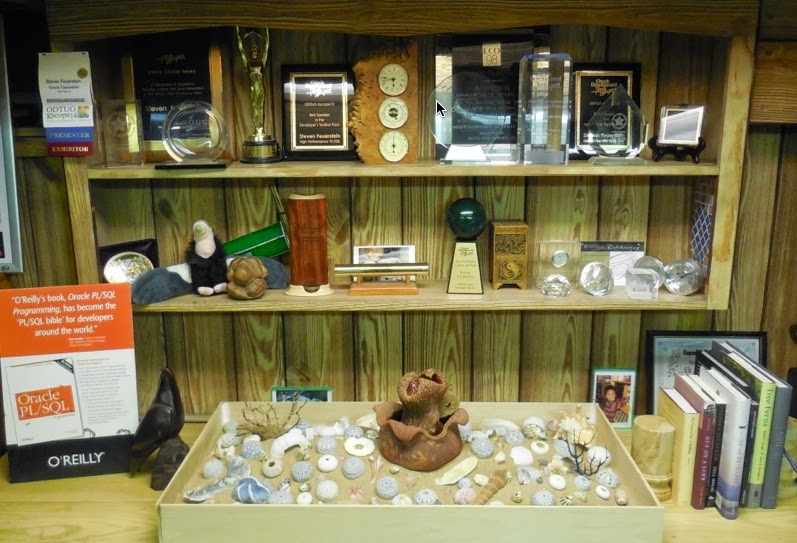
I re-established my sand table with beautiful pieces by Terry Hogan, and many other shells and coral from the sea:


And I put some of my awards and other mementos up on shelves that used to hold a small library of science fiction/fantasy books:


So, yes, settling in to my new office. And last night I started nailing up corkboard tiles to the thick wood paneling, so I could pin up photos of my granddaughter, Loey. Oh, I suppose other people, too. But Loey mainly, because she is the light of my life, and oh my she is a bright light.


In any case, as I hammered the tiny nails needed to hold up the corkboard, I became aware that I felt kind of down, as if the day had not gone well. Why would I be feeling that way? It had been a good day. And then I (the conscious part of me) realized that the non-conscious part of me was feeling bad about having broken a branch in the woods earlier in the day.

That sounds kind of weird, right? I mean, seriously, how bad are humans supposed to feel about breaking the branch of a tree? It's not like they'd notice, right?

But it made perfect sense to me, so I decided to share with you why a broken branch would set my brain to brooding, thereby giving you a sense of how I see the world these days.

As to why anyone should care what I think of the world, well, I leave that entirely up to the reader. No readers, then no one cares. :-) 

As soon as the thought (brooding about broken branch) broke into my consciousness, I immediately knew it was true (that happens to you, too, right? You can instantly sense that a thought is correct. Now try thinking about what is going on in your brain for this to happen and how much of your brain is the "I" that is you). 

You see, I had earlier been thinking back over to when I was in the woods this morning cutting down buckthorn. At one point a rather large tree came down hard against a nearby native tree I was working to rescue. 

To my great dismay, one of its branches was caught by the twisty, grabby buckthorn. It snapped and hung loosely. I did that. That was probably two years' new growth, hard work against buckthorn. And I killed it. 

That bummed me out (and still does), but I reminded myself that I have to accept that even when I move carefully and always safely, I cannot always control where a large tree will fall. I will make mistakes and there will be setbacks. But I just have to keep going.

"Going where?" you might ask. I have developed a new, very strong compulsion: to rescue trees. To do what I can with my own hands, with my own time, with, in other words, a solid chunk of my life, to heal some of the damage we humans inflict on our co-inhabitants and the planet itself.

I think about it as direct and positive action, a principle I attempt to follow in all aspects of my life these days.

Here in Chicago, buckthorn - an invasive import from northern Europe - grows aggressively, crowding out the native trees. In particular, they don't allow young trees, the saplings, the next generation of the natives, to survive. And as the buckthorn grows taller,  it also kills off the lower branches of the mature trees. 

Buckthorn is really an impressive, powerful, successful species. I admire it greatly - and I cut down on the order of 200 buckthorn trees a week (many of them quite small, but not all). Contradiction? Not at all. A necessary corrective action to human abuse of our world. We travel about, carrying with us the seeds (and ballast and larvae) of destruction for many ecosystems.

I do not want to lose our native trees (and even the non-invasive imports). I want my children and grandchildren to enjoy forests. I want to respect trees, since we could never have evolved to what we are today without trees. And even today the forests of the world are absolutely critical to the functioning of the global ecosystem(s).

I want to treat trees with respect and do penance for our cutting down 95% of the trees in the continental US. So I go out and rescue trees. It is now my only form of exercise and it keeps me in great shape - especially for picking up, carrying and playing with Loey. She loves for me to hang her upside down by her ankles and swing her like a pendulum. She trusts me implicitly. I love that.

Sorry, you must be wondering: what is the point of all this? 

To give me an opportunity to marvel at the current state of my life, in which I have quite an intimate relationship with trees. I study them, I read them. Really, it's quite amazing. I can go into the woods now, look at how a native tree's branch has withered, identify the buckthorn that is doing the damage, and actually play it out in my mind's eye: years of slow growth, of slow-motion battle, and of losing it to the buckthorn. Everywhere I look, I find the trees telling their stories.

My greatest joy is to uncover a small sapling that was so completely surrounded and covered by buckthorn I didn't even see it there when I started cutting. Then I open it to the sun and the wind. I did this with a lovely 15 foot tall maple sapling last week. I will be visiting it (and hundreds of other trees) each year now, making sure the buckthorn (and grapevine) leaves it alone, allowing it to grow to a big, thick, incredibly strong and life-giving tree.

There, right there, that's what I marvel at: I know that the 10+ hours I spend each week in the woods rescuing trees will mean that 20 years from now there will be trees with a diameter of a foot or more that simply would not be there if it hadn't been for my effort and my attention paid to something other than human stuff.

That makes me feel happy and less guilty about my consumption (and indirect killing of many, many trees). It gives me a purpose in life, besides family and work.

I plan to rescue trees for as long as my body is able to do the work.

Anyone care to join me?


Sunday, September 21, 2014

This is not my kingdom

I don't know most people in Chicago on an individual basis, but of all the people I don't know, my favorite Chicagoans are scavengers. They roam the alleys in beat up pickup trucks, with various kinds of makeshift walls extended above the bed.

They grab anything made of metal and anything with the possibility of value. They reduce the amount of garbage going to landfills and I thank them very much for doing this.

Driving the other day, passed one such truck with a hand-lettered sign nailed to the wooden side wall. It said:

This is not my kingdom.
Just passing through.


Sunday, September 14, 2014

Eli and the Runaway Diaper now available!


In 2013, the big sensation in (my) children's publishing was the release of Vivian Vulture and the Cleanup Culture.

In 2014, the honor goes to Eli and the Runaway Diaper.

It's a book about a diaper that gets tired of the day in day out grind of covering Eli's bottom (the names have been changed to protect the innocent). It decides that it's time to look around for a new and hopefully better (more appreciative) bottom.

Eli is initially dismayed, but happy to join the diaper on its quest, so off they go on a grand adventure!

Illustrated by Robert Melegari, it's a fun, light-hearted journey to self-discovery and self-improvement.

You can order it on Amazon,  Createspace, and so on. But if you order it from me, I will sign it and ship it off to you, all for the list price of $12.99.

Monday, August 25, 2014

Flipping Herman Millers

I was one of those dot.com boom excitables who decided that he must own a Herman Miller Aeron chair in order to be super cool and incredibly productive while I blogged and tweeted (well, I don't think there was Twitter back then) and so forth.

Soon after I got the chair, I realized that I really didn't like it very much at all. It didn't seem to provide support in the right places, didn't make it easy to avoid slouching....it wasn't the desk chair for me.

[My chair of choice, for years now, is the Swopper.]

Tried to get my son interested. Nope.

Tried to get my wife interested. Nope.

Moved it to the garage. 

Finally decided to offer it up on Craigslist nice and cheap to make it go away. Posted the ad for $200 and within minutes had someone lined up. He lived in St. Louis, but his dad lived nearby, and he told me when picking up the chair:

His son has built up a business "flipping" Aeron chairs. Buy them cheap, buy lots of parts, fix 'em up, and spin 'em back out into the market. 

Who knew?

What a remarkable system is capitalism. Sure, it's not nice. It's not fair. It's played a key role in the destruction of our planet as humans suck out the "natural resources" to make all the stuff that consumers want to buy. 

But capitalism is a very organic way of organizing an economy. 

Oh and this same chair-flipping fellow also does a wholesale business in ugly Christmas sweaters.

Finger on the pulse of a nation.

Tuesday, July 01, 2014

July 1, 1858: Co-discovery of Evolution by Natural Selection

On this day in 1858, members of the Linnaean Society of London listened to the reading of a composite paper, with two authors, announcing the discovery of evolution by natural selection.

One author you've probably heard of: Charles Darwin

The other? Famous in his time, but in the 20th and 21st centuries largely forgotten: Alfred Russel Wallace.

Darwin was a Big Data scientist, spending 20 years after his trip to the Galapagos gathering data from his own experiments and from botanists around the world, to make his theory unassailable. Wallace was a field naturalist, studying species and variation, up close and very personal.

Both ended up in the same place at roughly the same time, driven by the inescapable conclusion from these three facts:

1. More organisms are born than can survive (for their full "normal" lifespan). 
2. Like father like son: we inherit characteristics from our parents
3. NOT like father like son: each offspring varies in some way from its parents.

So who/what survives to reproduce and pass on its genes? Or rather, who dies and why? You can die purely by accident. You are the biggest, strongest lion. Nothing can beat you. But a tree falls on you. Dead and gone.

Or you can survive because you have an advantage, however slight, that another in your species lacks. Your beak is slightly more narrow and lets you get at all the nuts on the tree. Your legs are slightly longer so you can avoid the tiger. And so on, everything sorting out how to eat, how to survive long enough to reproduce, from bacteria to coral to fish to mammals.

And with each passing generation, the mutations that help you survive get passed along, and so we (humans and everyone, everything) change - sometimes slowly, sometimes quickly. But change we do. 

With this announcement on July 1, 1858, humans now had a way of understanding how the world works without having to fall back on some unknowable god or gods. And we have also been able to build on Wallace's and Darwin's insight to now understand, perhaps too well, how life works on our planet, and how similar we are to so many other species.

Which means - to my way of thinking - that we no longer have any excuses, we humans, for our ongoing devastation and depletion of our world and our co-inhabitants.

In a more rational world, in which humans shared their planet with everything around them, instead of consuming everything in sight, July 1 would be an international day of celebration.

Well, at least I posted a note on my blog! Plus I will go outside later and cut back invasives, to help native trees grow.

How will you celebrate International Evolution Day?

Here are some links to information about evolution, about the way these two men got to the point of announcing their discoveries, and more.

You will read in some of these articles about Wallace being "robbed" of his just fame and recognition; I must tell you that Wallace, in his own words and the way he lived his life, was gracious and generous in spirit. He always saw Darwin as the one who fully elaborated the theory, making its acceptance so instantly widespread across Europe. He did not seem the least bit jealous.

And Wallace was, in many ways, a far more interesting human being than Darwin. I encourage to check out his autobiography, My Life, as a way of being introduced to one of my heroes.

http://www.wired.com/2011/07/0701darwin-wallace-linnaean-society-london/

Monday, June 16, 2014

A terribly oblivious ultra-rich man

Steve Ballmer is a terribly oblivious ultra-rich man.

His offer of $2B for the Los Angeles Clippers is so ridiculously outsized and unjustified, plus it so richly rewards Sterling for, um, for saying something in private.

[Interesting to consider how in the US, land of free speech, this nasty brutish fellow is being punished -well he was being punished before Ballmer rewarded him - for his private thoughts. That's pretty awful when you think about it.]

Anyway back to Ballmer. His offer is so absurd that it becomes patently obvious to everyone that he has so much money it's simply no big deal for him to throw $2B on the table to unambiguously cinch the deal. 

The aristocracy in France did quite well, too, until they forgot that they were supposed to pretend at lesat a little bit that everyone else weren't virtually slaves for them. But when they got too flagrant, they paid, oh how they paid.

And here in the 21st century, in what is supposedly and still formally a democracy, with citizens supposedly being equal under the law, you really don't want to draw attention to your beyond obscene wealth.

Bad move, Ballmer. If I were a fellow billionaire, I'd get in touch and tell him to tone it down. 

The closer you look....

In the last couple of years, I have shifted my attention away from the human condition (wars here and there, cool new gadgets, etc.) to the non-human condition: the natural world of trees, water, creatures large and small, the process of evolution.

Along the way, I have been reminded that what you pay the most attention to is what your brain spends the most time thinking about (at least the parts of my brain that "I" am "conscious" of). So I need to be careful about what I pay attention to (one reason that I have stopped watching television almost completely). 

And spending ten plus hours a week outdoors, in the woods, cutting back invasives and rescuing trees, has reinforced this to me:

With living things, the more I watch and more closely I watch (and smell and taste), the more amazed I am by the wonders of life. And the more alive I feel,

With manufactured things, it is just the opposite.

The more closely I look at something made by humans, the more sterile, dead and energy-sucking it appears. And the more I watch (or smell or taste), the more deadened I feel.

Perhaps this is not such a big surprise, since everything that humans make is dead, and built upon the deaths of many creatures. Sorry if that sounds like such a downer, but I believe it is simply a statement of fact.

Anyway, no need to feel down. Just go outside, into the trees, into a field, away from things we make, take a deep breath, feel the sun on your face....and you will feel much better.

Thursday, May 29, 2014

Do animals have souls?

OK, first of all, don't tell me your answer to this question. That would make the rest of this post seem a bit rude.

Here is one of the dumbest questions I can ever imagine a person asking, much less answering:

Do animals have souls?

How utterly ridiculous.

No one knows what a soul is. No one knows what it looks like, what it means, whether or not it really exists.

Furthermore, we certainly have no idea - please allow me to repeat that because I think it is so fundamental to accept this as fact: we have no idea at all - of what is going on inside an animal’s head. Clearly, a whole lot is going on, if you take the time to pay attention to animals and think about what it takes to do what they do. But many of the things humans blithely state as fact regarding animals, such as “They don’t know the difference between right and wrong.” is fundamentally meaningless because we simply cannot know what is going on inside another creature’s mind. We just make the assumption that they are really super different from us in all the ways that matter - to us.

We are intelligent, moral, sentient. We are smart and they are dumb, brute animals. We are conscious, we have history, philosophy, nuclear power. What do animals have? Nothing!

Oh really? How do we know what animals have? Or even what “have” means to a butterfly or a snake or a black bear? Again, we really have no idea whatsoever what animals have, what they want, or how they would feel about killing others just to make themselves comfortable (something that we humans do every second of every day).

So we make the most self-serving assumption imaginable. We simply outright declare that other creatures have no souls, are not sentient. They are food or threat or benign, but they are not like us.

We will continue to reject the evidence of our senses, the clear demonstrations of sentience, of complex social structures, in other animals. That way we don’t have to feel bad about enslaving them and killing them. Think for just a moment about how smart pigs are, and then think about pig farms in which tens of thousands of these poor creatures live short miserable lives - brought into this world for the very purpose of slaughtering them for bacon. And then later a dam bursts and an entire town is swamped with pig feces from the refuse lake at the farm. Go, humans, go!

I sure am glad there wasn’t and isn’t a species of creature on this planet that's three times our size, extremely powerful and licking its lips at the prospect of a nicely smoked human torso. 

We do not know what goes on inside a pig’s head, but it sure seems like they can feel and express terror. 

So, yes, humans will keep on keeping on, keep on consuming, reproducing, and assuming. But that doesn't mean we can’t try to recover a shred, a mere shred, of our individual dignity by at least acknowledging what we are doing, and taking at least one step, no matter how small to help heal our planet and our co-inhabitants.

We can start by acknowledging, accepting, that the thing that we believe makes us unique and special among all living things is simply an unknowable assumption we make. It is an arbitrary, self-serving action - and brings into question the very idea that humans can be considered moral creatures. 

Thursday, May 01, 2014

Bill Cosby the Mathematician

Leafing my way through the Chicago Reader, I came across this ad:


It took me a moment to sort it out. Can you?

And I don't even know what it is an ad for. Maybe he is coming to Chicago soon for a show? Maybe his greatgrandchild said "Hey, Great Grandpa, look what I learned in school today!" and BC was just so taken with the idea - and the fact that his own clever descendent came up with it, that he decided to run it as an ad.

In any case, generally I hate ads, but I sure like this one.

Ha! Or maybe it is old as can be (as in dating to at least 2011) and I am just catching up:

http://weknowmemes.com/2011/11/sin-b-tan-b-equals-cosby/ 

Well I've never pretended to keep up.